Table-top assembly
Bond a coated wood-based panel into a compatible plastic frame. Pressure-sensitive hotmelt can provide an assembly bond suited to the substrate combination and production sequence.
 ADHESIVE PIONEERS
WHITE GOODS / ASSEMBLY ADHESIVES
Elastomer-based pressure-sensitive hotmelts for appliance assembly. Explore table-top bonding and compatible trim, foam and damping-material applications.
Explore bonding areas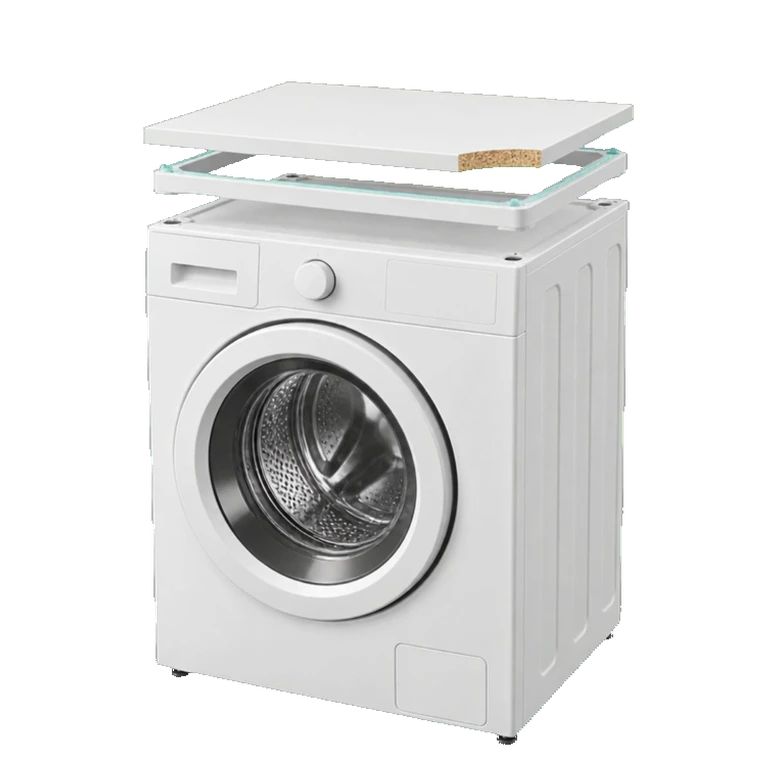
APPLIANCE ASSEMBLY
Washing machines, dryers, dishwashers and refrigerators combine dissimilar materials. Their assembly bonds must be selected for the actual temperature, moisture, vibration and loading conditions.
Bond a coated wood-based panel into a compatible plastic frame. Pressure-sensitive hotmelt can provide an assembly bond suited to the substrate combination and production sequence.
Evaluate HMPSA for compatible damping pads, foam pieces and insulation facings. Check the bond to the actual metal, plastic or coated surface under the component’s service conditions.
Explore bonding of compatible trims, plinths and cover components where permanent tack and controlled assembly time are useful. Joint design and load determine suitability.
Separate the panel from its frame to explore the coating, supporting ledge and assembly bond.
Schematic section · adhesive thickness enlarged for clarity
Review the actual panel coating and wood-based substrate, including exposed edges. The bonding surface is part of the material selection.
Bring representative coated panel samples to the trial.THE TABLE-TOP INTERFACE
Elastomer-based HMPSA remains pressure-sensitive after cooling. Good surface contact and suitable pressing conditions are central to the assembly process.
Select the formulation for tack, viscosity, working time and resistance to creep at the intended service temperature.
Check the actual panel coating and wood-based substrate, including any exposed edges.
Evaluate adhesion to the specific frame resin, surface condition and joint geometry.
Where a design requires reactive PUR edge sealing, specify and validate that separately from the elastomer-based HMPSA assembly bond.
FROM SAMPLE TO PRODUCTION
Check the panel, frame, coating and surface preparation with production samples.
Evaluate application viscosity, adhesive pattern, working time and pressing conditions.
Assess creep, peel and bond integrity after representative heat, humidity and vibration exposure.
ADHESIVE SOLUTIONS
HIGH PERFORMANCE HOTMELT ADHESIVES

Explore OYTITHERM elastomer-based HMPSA for compatible appliance assembly applications. Grade selection follows your materials, joining process and required thermal and mechanical performance.
Explore OYTITHERMAPPLICATION DEVELOPMENT
Bring representative panel/frame assemblies, damping materials or trim samples. Share the actual service conditions so the proposed bond can be evaluated on the component.
Discuss your applicationLET’S BUILD THE NEXT BOND.
Tell us about your materials and your production process. Let’s explore the right adhesive together.
Talk to our team info@oyti-adhesives.com+90 226 400 00 27