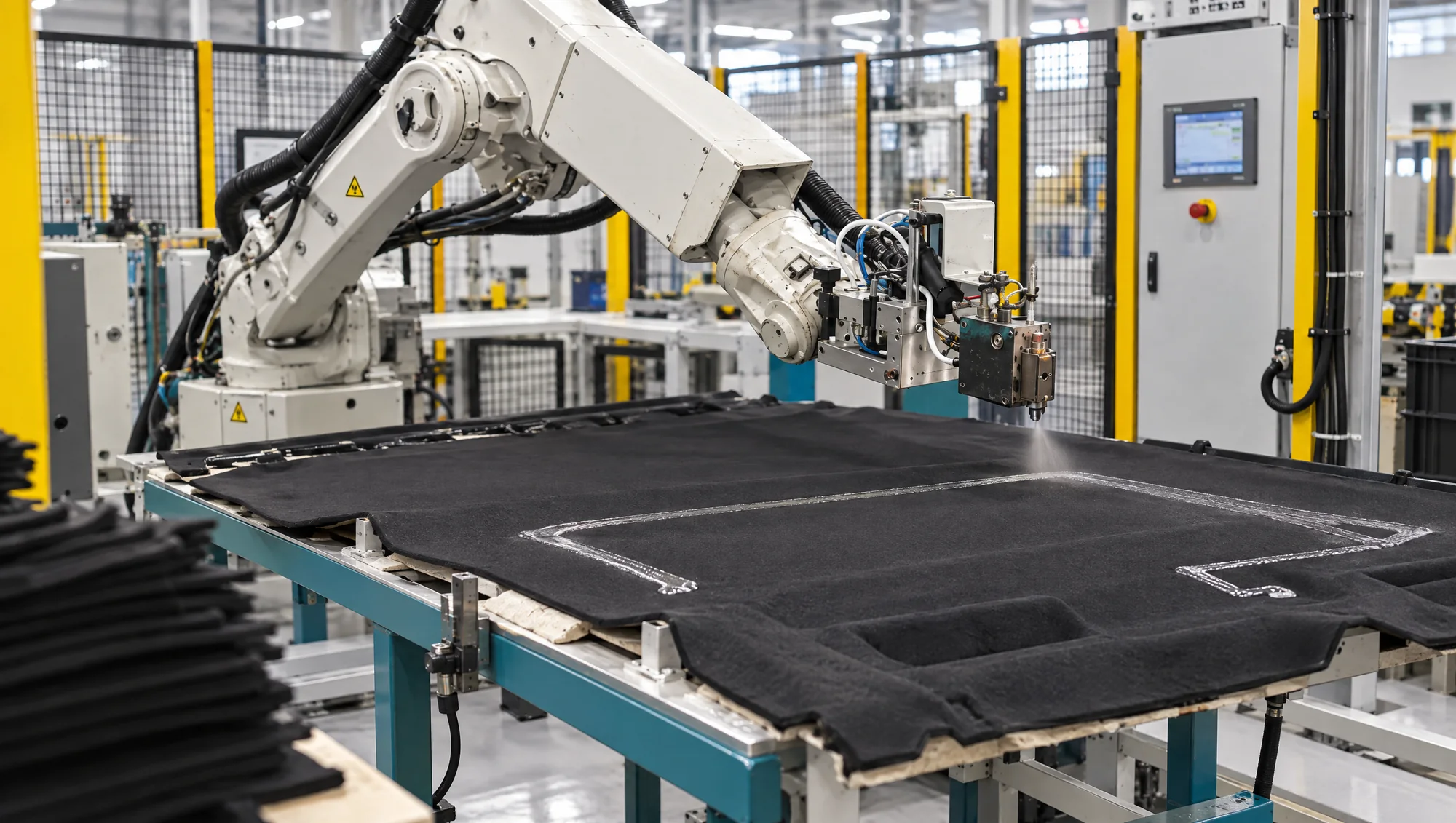
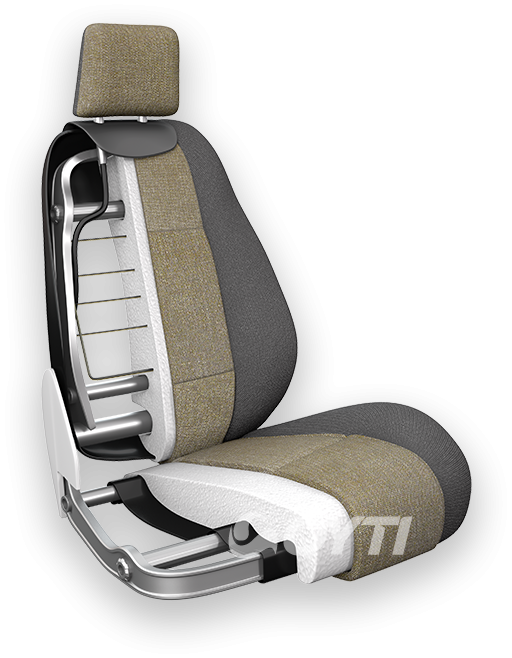
From seat assemblies to carpet trims, acoustic felt, luggage covers and headliners. OYTI adhesives connect the materials behind a quieter, carefully finished vehicle interior.
REACH, SVHC, heavy metals and VOC belong in the same conversation as adhesion and durability. Explore the questions behind each requirement.
REACH
The right document. For the right grade.
REACH brings substance information, restrictions and authorisation requirements into material selection. Review the obligations relevant to the adhesive and its intended use.
Adhesive grade & intended use
Relevant substance requirements
Document date & revision
Request grade-specific documentation with an issue date, intended application and relevant scope. A safety data sheet and a test report answer different questions.
SVHC information should identify the adhesive grade and the Candidate List date used for the review. Candidate List inclusion can trigger specific communication obligations.
Candidate List reference date
Product-specific substance information
Scope of the material or article review
Review current substance information with your technical contact. Carry the identified grade and revision into the component documentation.
Lead, cadmium, mercury and hexavalent chromium are examples of substances addressed in automotive material requirements. Define the applicable specification and the target substances before commissioning analysis.
Target substances & specification
Sample identity & analytical method
Reporting limits & acceptance criteria
Agree the sample, analytical method, reporting limits and acceptance criteria. The report must identify what was tested; it should not be read as a blanket statement about every product or component.
Adhesive: define the sample preparation and conditioning for the specified method.
VOC
Consider what enters the cabin air.
VOC and other emissions are evaluated using defined sample preparation, conditioning and analytical methods. Odour and fogging provide additional information about interior material behaviour.
Sample preparation & conditioning
Specified method & reporting units
Adhesive, laminate or complete component
Consider the adhesive together with its covering and carrier. A material-level result does not automatically describe the emissions of a complete interior component.
A vehicle interior is a family of bonded components. Shaped carpet panels, acoustic pads, rigid reinforcements and decorative surfaces each need an adhesive matched to their materials, process and service conditions.
Carpet, felt and nonwoven bonding
Wood-fibre and rigid carrier laminates
Seat assemblies and decorative trim
Heat, ageing and cabin-air requirements
INTERIOR TRIMS / THE MATERIAL CONNECTIONS
Many parts. One connected interior.
From a small acoustic pad to a full-size lining, the right bond connects each material to its purpose.
01
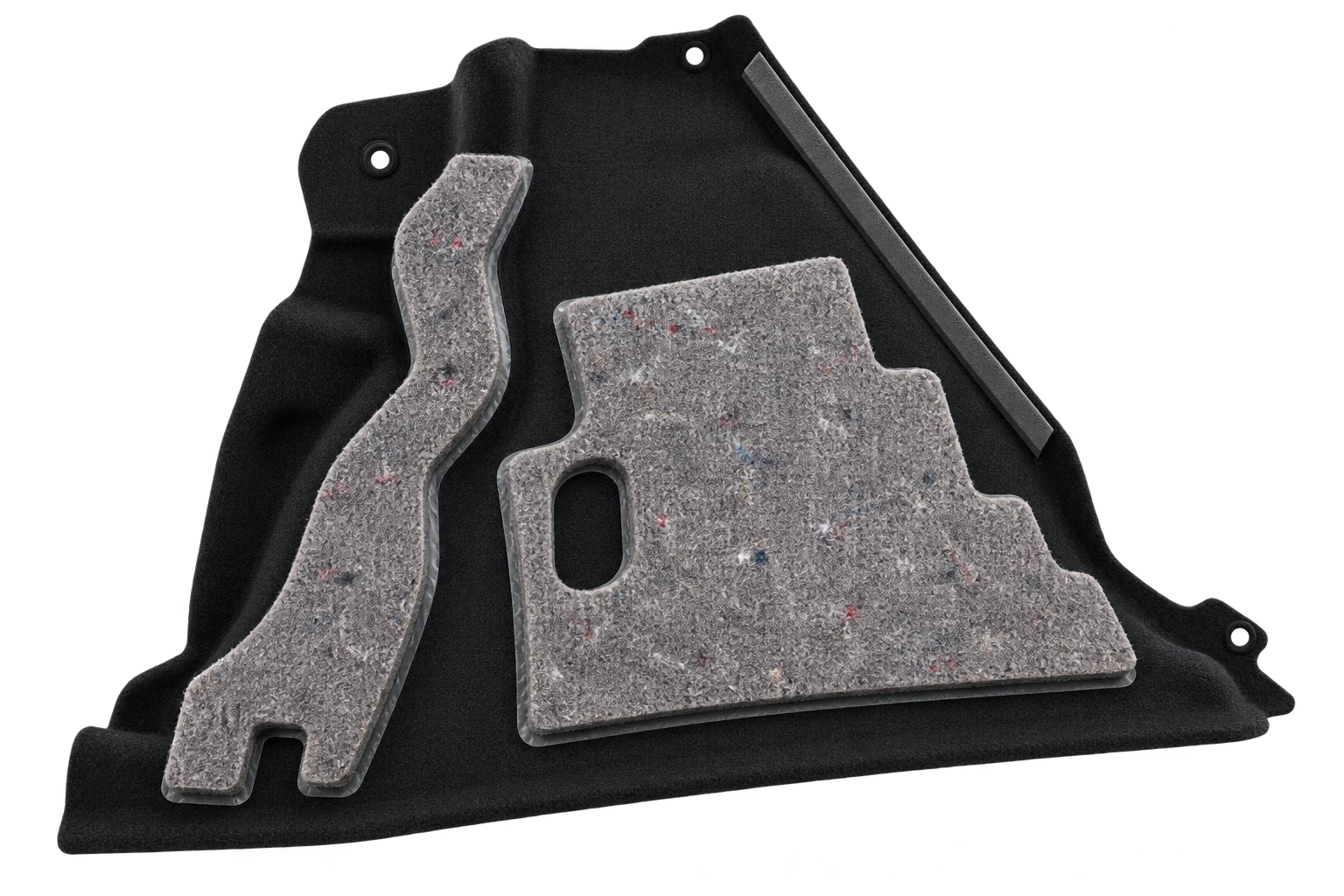
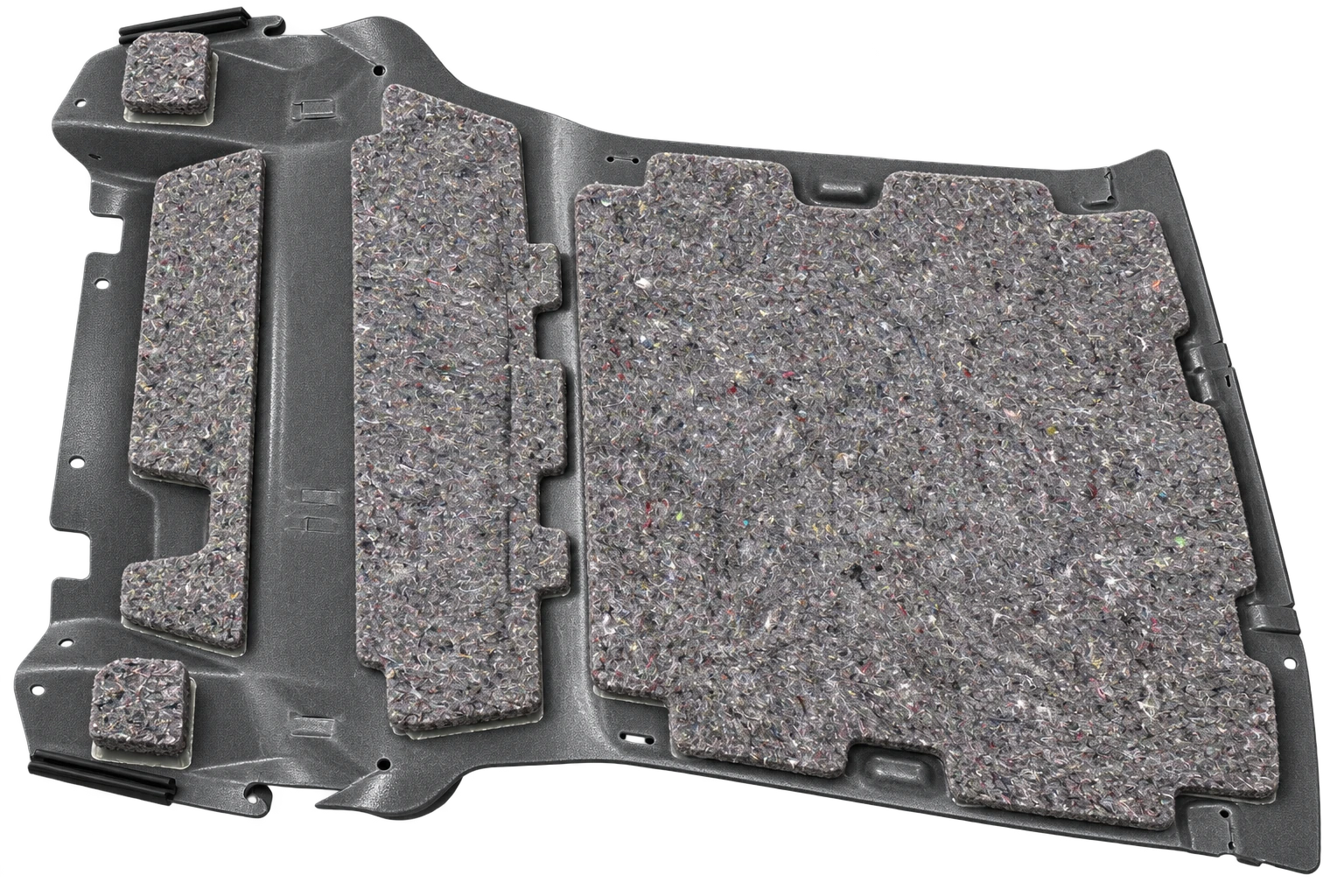
Sculpted side trims
Shaped carpet, cut-to-fit acoustic felt and local reinforcements come together in one contoured part. OYTITHERM hotmelts support bonding between suitable trim layers.
Carpet carrier
Acoustic felt
Reinforcement
What to assess +
Contour contact
Review adhesive contact on tight radii and around reinforcements. Include thermal ageing and the relevant emissions requirements in the agreed validation plan.
02
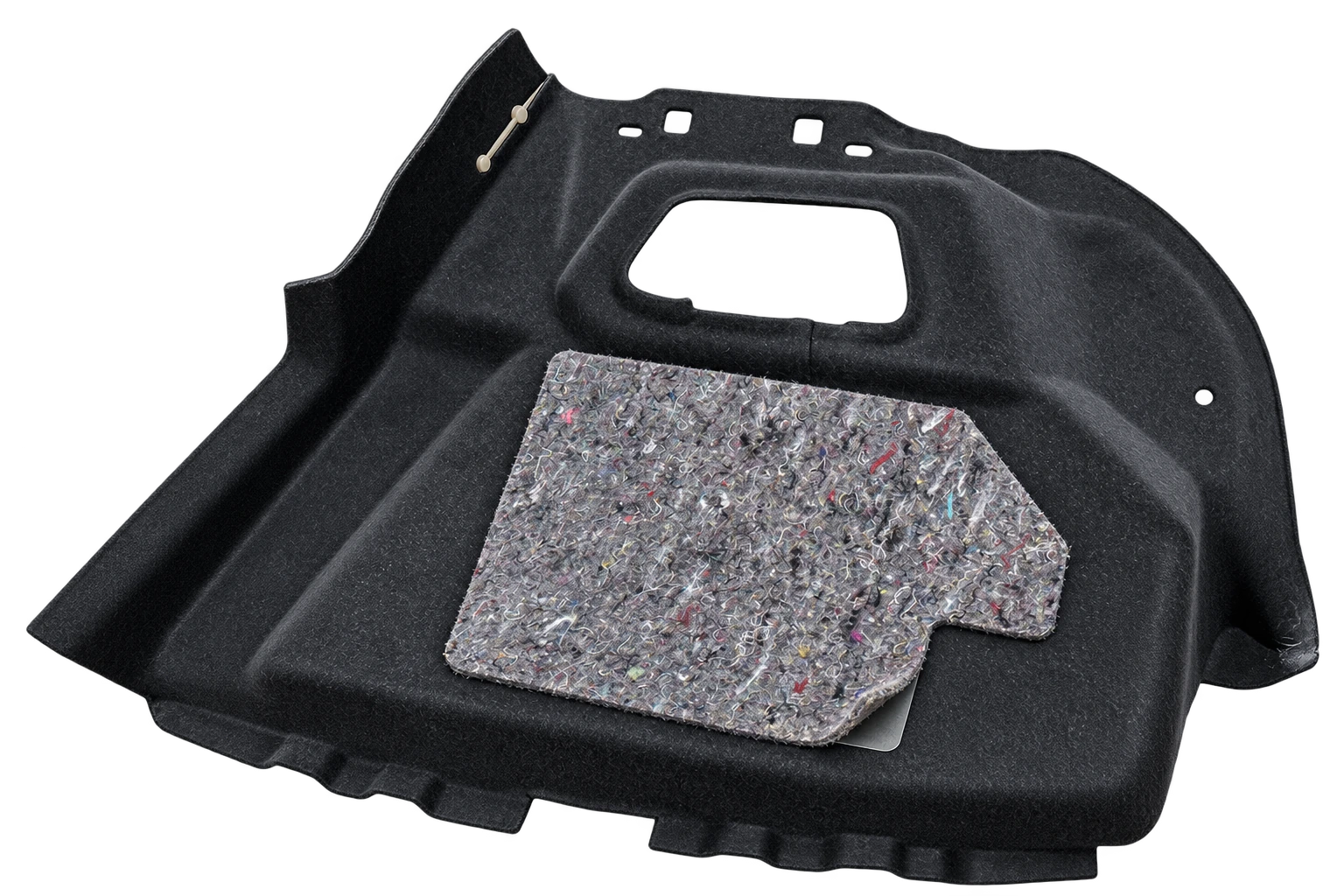
Local acoustic elements
Smaller felt pads follow complex carrier contours, with openings and fixing points kept clear. The adhesive is selected for the actual substrate pairing and application process.
Contoured carrier
Local felt pad
Adhesive interface
What to assess +
Pad placement
Keep openings and fixing areas clear. Check pad retention after handling and conditioning, and assess the complete material combination.
03
Large-format interior liners
Broad interior panels combine several acoustic zones on a single shaped carrier. Local pad attachment and edge bonding need consistent placement and reliable contact.
Large carrier
Multiple felt zones
Local attachment
What to assess +
Broad-area consistency
Evaluate local contact, edge lift and placement across the large carrier. Use representative sections when defining sample locations.
04
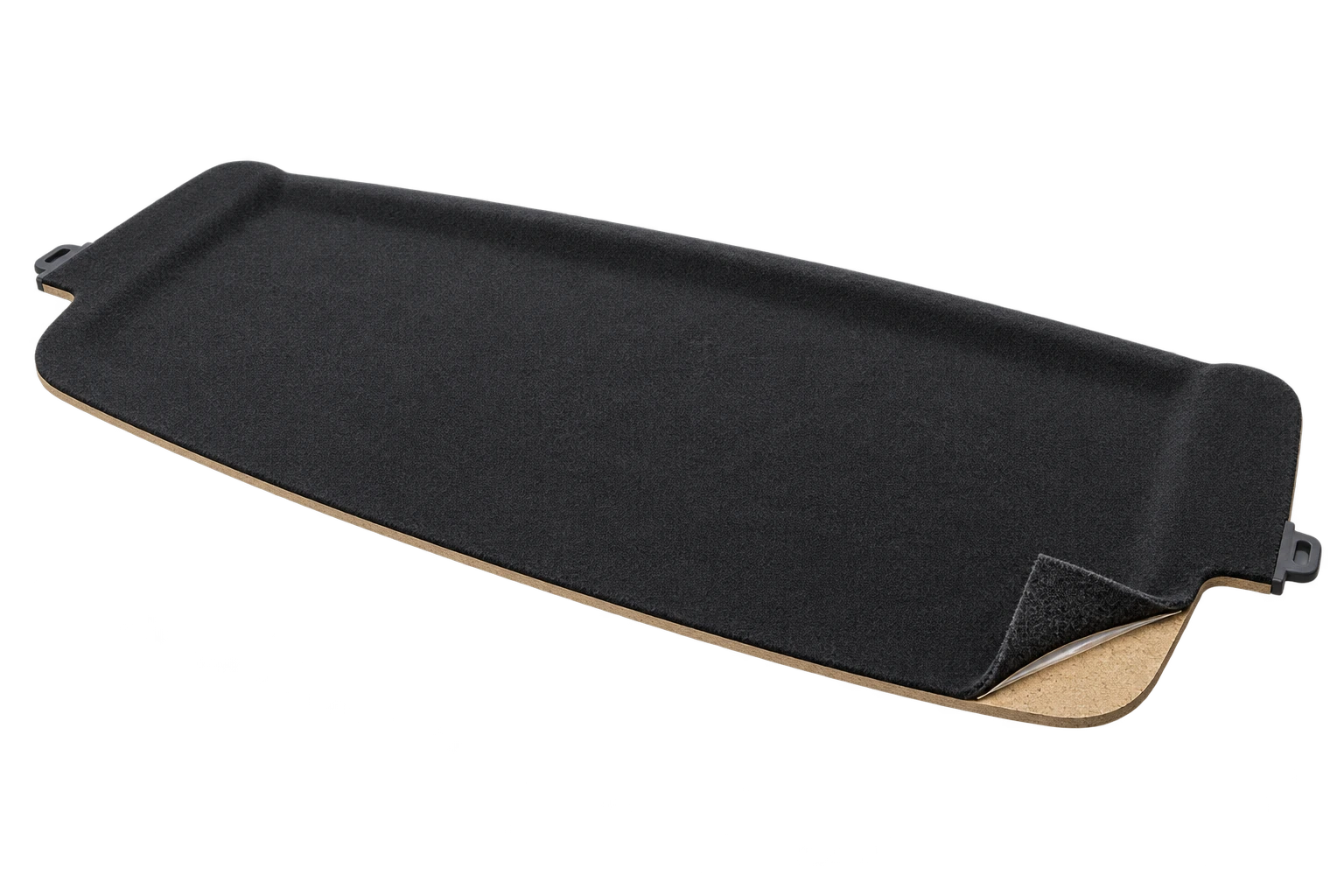
Luggage compartment covers
Black automotive carpet laminated to a wood-fibre board creates a finished luggage cover. The cutaway reveals the carrier, adhesive interface and textile covering.
Black carpet
Hotmelt bond
Wood-fibre board
What to assess +
Laminate integrity
Check carpet-to-carrier adhesion and the appearance of the finished surface. Include the specified heat, ageing and cabin-air assessments.
Illustrative 3D views show typical bonding interfaces. Layer separation is shown for clarity; component construction and adhesive selection depend on the application.
HEADLINER / TEXTILE LAMINATION
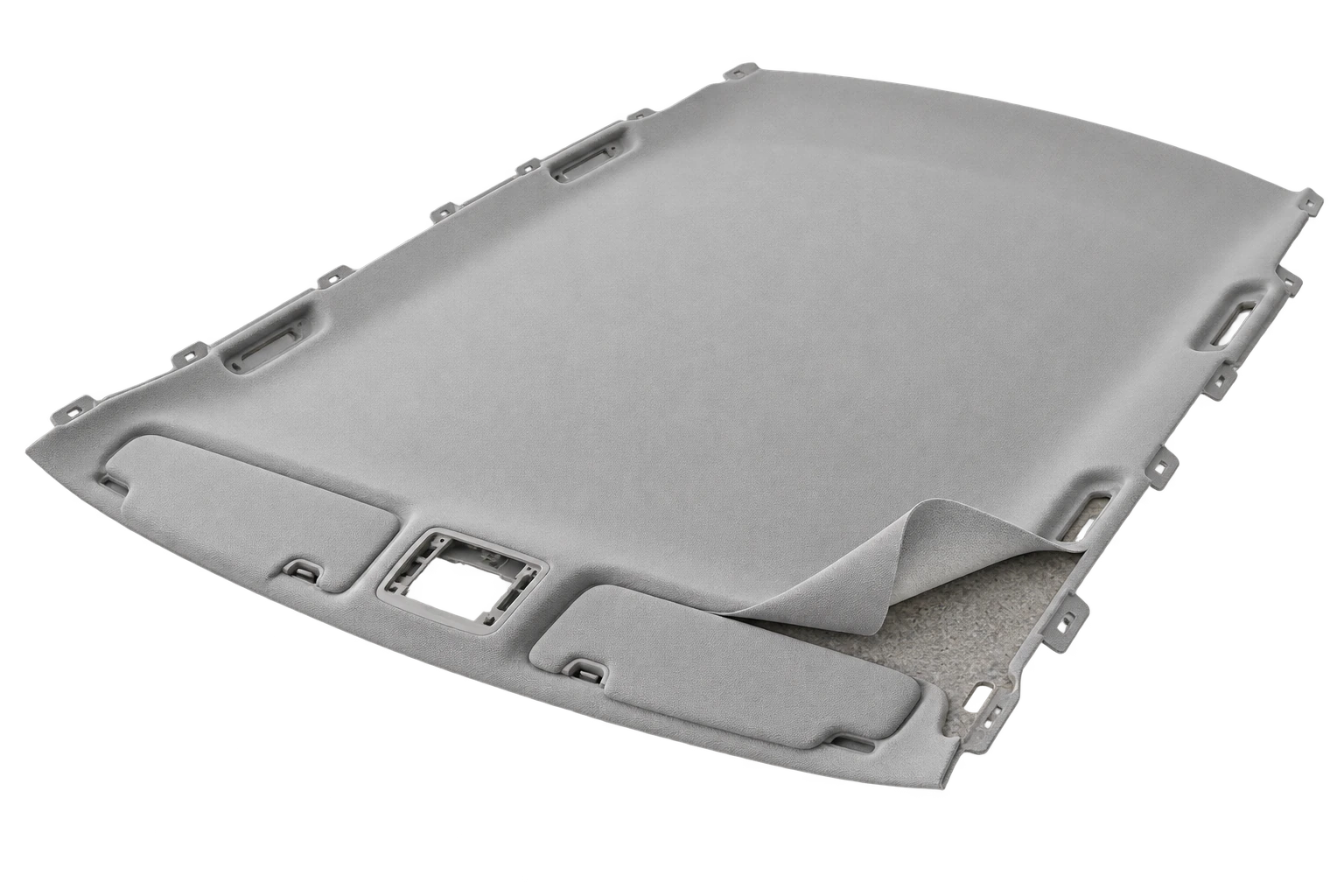
Comfort, above every seat.
A formed carrier gives the headliner its shape. The textile facing provides the visible finish. OYTIPUR polyurethane dispersions support lamination of suitable coverings to the carrier, with activation and bonding conditions matched to the materials.
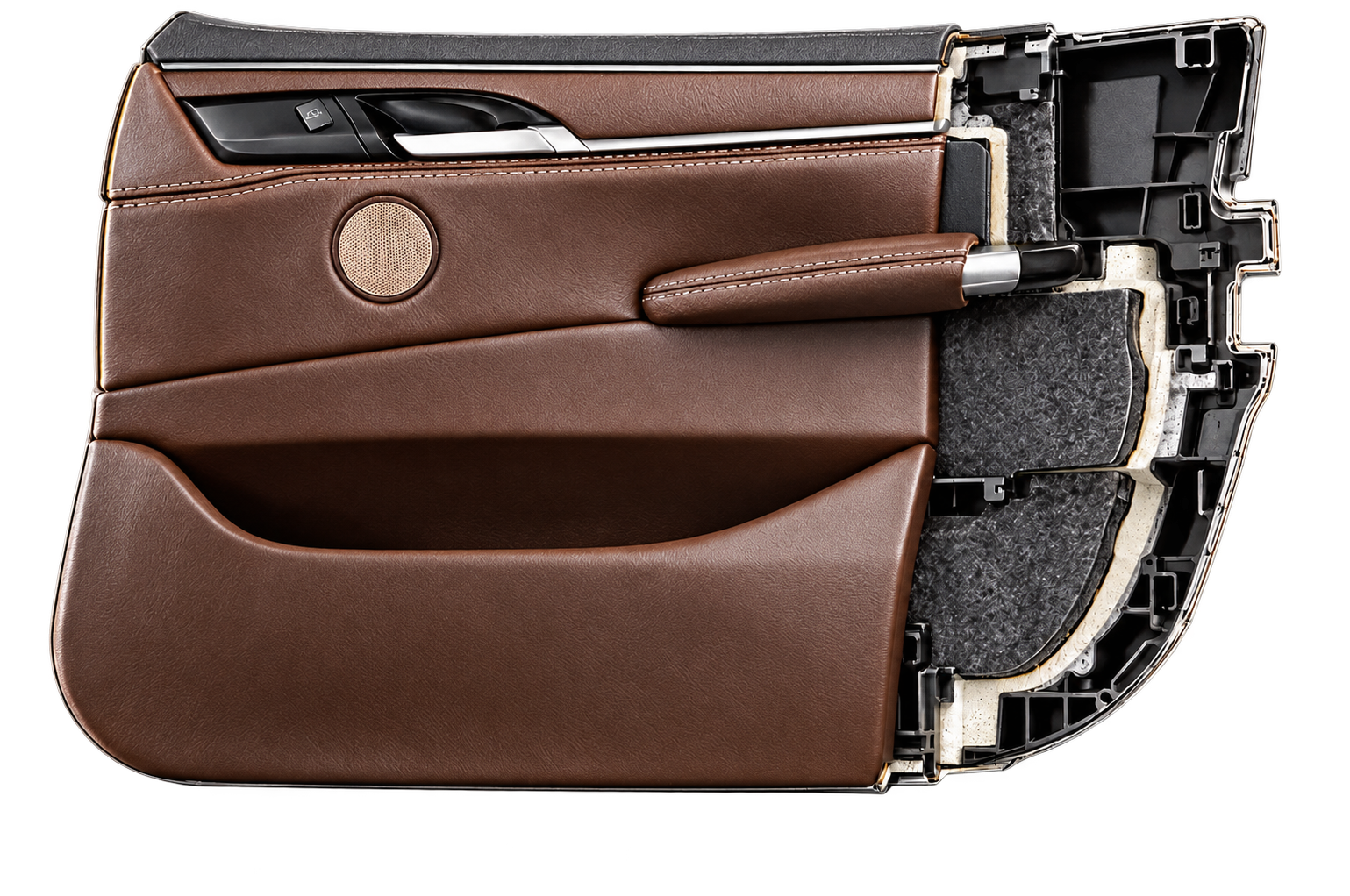
Alongside OYTITHERM hotmelts for carpet, felt and reinforcement bonding, OYTIPUR polyurethane dispersions support heat-reactivated lamination of suitable decorative coverings to door-panel and headliner carriers.
We work with IMAT UVE and SGS for external testing. The laboratory, test programme and sample scope are agreed around the requirements of each automotive project.
Review the technical data sheet, safety data sheet, batch documentation and agreed test methods together. Match the adhesive to the actual substrates, application conditions and customer specification.
Material & batch→Method & conditioning→Report & review
Testing supports the project assessment. Product or OEM approval must be confirmed for the relevant grade and application.
AUTOMOTIVE / TESTING & VALIDATION
Demanding interiors. Measured performance.
Bond strength is only part of the story. Heat stability, ageing, odour, fogging and emissions also shape automotive material selection.
Automotive specifications bring together mechanical performance, cabin comfort and material behaviour over time. OYTI supports adhesive selection around the component, its manufacturing process and the validation requirements of each project.
Bond integrity
Adhesion, peel resistance and the behaviour of the complete material assembly.
Durability in service
Stability through heat exposure, humidity and climatic ageing.
Cabin comfort
Odour, volatile emissions and fogging considered alongside bond performance.
Explore automotive test methods+
Key test areas for automotive adhesive and laminate evaluation
Test method
What it evaluates
Why it matters
Peel strength
Resistance to separating bonded layers, including testing after ageing.
Evaluates adhesion and identifies whether failure occurs in the adhesive, at the interface or in the substrate.
Heat resistance
Bond integrity and dimensional stability during elevated-temperature exposure.
Assesses risks such as lifting, blistering, deformation and delamination.
Climatic ageing
Response to defined temperature and humidity cycles.
Examines how the laminate retains adhesion, shape and function under changing conditions.
Odour assessment
Sensory evaluation of conditioned material samples using the specified panel method.
Supports interior material selection with passenger comfort in mind.
Fogging
The tendency of volatile constituents to condense on a cooler surface.
Assesses condensable emissions from interior materials.
VOC & aldehyde analysis
Volatile organic compounds and specified substances such as formaldehyde, using the agreed analytical method.
Supports cabin-air specifications and evaluation of the complete material combination.
Burning behaviour
Flame propagation and burning characteristics under defined test conditions.
Evaluates the assembled material against the applicable flammability specification.
Targeted substance analysis
Specified substances, including heavy-metal targets where required by the project.
Relates the result to the sample, analytical method, reporting limit and applicable material specification.
Working to a particular automotive specification?
Share the component, adhesive grade, target specification and required test scope. We will help identify the next documentation and validation steps.
Test methods, conditioning and acceptance criteria are agreed for the relevant component and customer specification. Validation considers the adhesive together with its substrates and application process.
MATCHED TO YOUR PROCESS
Explore the adhesive solutions.
Start with a product family. Then select the grade for your application.
HIGH PERFORMANCE HOTMELT ADHESIVES
Hotmelt solutions for seat assembly, carpet and felt lamination, acoustic-pad attachment and interior-trim reinforcements. Select the adhesive grade for the material combination and production process.
Heat-reactivated polyurethane dispersions for suitable decorative coverings and interior carrier parts, including door panels and headliners. Select the grade and activation conditions for the substrate combination.