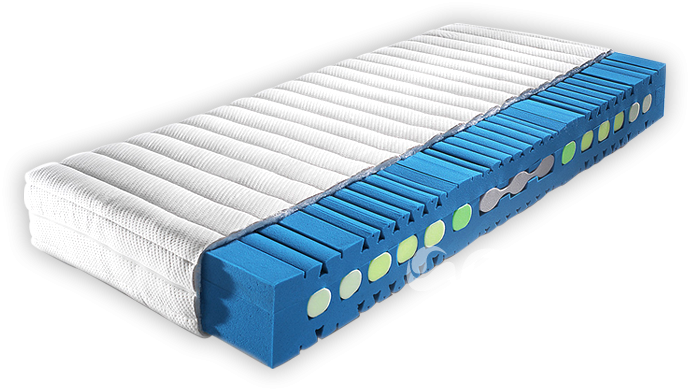
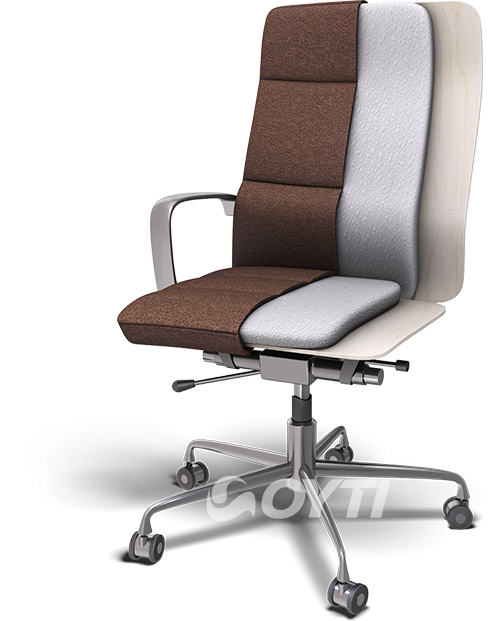
Latex-free. Built around your needs.
Our contact dispersion adhesive is completely latex-free. Its more flexible bond seam follows soft materials, supporting comfort in foam and upholstery assemblies.
 ADHESIVE PIONEERS
WATER-BASED CONTACT ADHESIVES

Completely latex-free, water-based contact dispersion adhesives for foam, upholstery and mattress production. Flexible bond seams, greater UV resistance and overspray-free spray application.
OYTITACK / MATERIAL-CONSCIOUS DEVELOPMENT
Your material requirements. Our starting point.
A more consistent material composition starts with the complete construction: foam, adhesive, covers and any additional layers. Bring your material targets into the adhesive discussion from the beginning.
Discuss your material conceptOur contact dispersion adhesive is completely latex-free. Its more flexible bond seam follows soft materials, supporting comfort in foam and upholstery assemblies.
For a PU-foam concept, a compatible latex-free adhesive is one route to investigate. Suitability depends on the complete formulation and the intended recovery process, not simply a shared polymer name.
Include the adhesive in recycling trials with the relevant process partner. Collection, separation, additives and other mattress components all influence what can be recovered.
Our contact dispersion is completely latex-free. Recycling compatibility remains a separate property and must be validated for the complete construction.
LATEX-FREE CONTACT DISPERSIONS
Completely latex-free contact bonding for foam and upholstery: a more flexible seam, greater UV resistance and overspray-free application.
More flexible than conventional latex-based contact dispersions, the bond seam moves with soft foam and upholstery materials. It supports comfort and integrates more naturally into the finished component.
The latex-free formulation offers greater UV resistance and avoids the brown discolouration associated with ageing conventional polychloroprene-latex dispersions. It helps preserve the appearance of light-coloured materials.
Our formulation is designed for overspray-free spraying, helping keep adhesive on the intended bonding area. Cleaner surrounding surfaces mean less adhesive loss, less contamination and less cleanup around the work station.
Match the nozzle, pressure and spray distance to the recommended application setup.OYTITACK / TECHNOLOGY
OYTITACK combines the needs of foam assembly with water-based adhesive technology. Product selection focuses on initial tack, airing time and how the adhesive reaches the component.
01 / CONTACT BONDING
Designed for foam and upholstery work where a component needs to hold its position during assembly. Select the grade around the materials and bond geometry.
02 / APPLICATION
One- and two-component systems support different production setups. Discuss spray application, roller application and assembly timing with our team.
03 / SUPPLY SYSTEM
Explore suitable OYTITACK grades and bag-in-box supply for gravity-fed application as an alternative to pressure-tank feed.
OYTITACK / THE BOND BEHIND COMFORT
A foam bond has more than one job. It must support assembly, follow the contour and work with the feel of the finished component.
Assembly tack helps keep parts in position while a bond develops. It is a different checkpoint from final strength: assess both the first handling step and the fully conditioned assembly.
Our latex-free contact dispersion creates a more flexible bond seam than conventional latex-based dispersions, helping the bonded area compress and bend with the surrounding foam. The result supports comfort and better integration into soft upholstery materials.
Curved foam, wrapped edges and folded covers can pull against a fresh bond. Trial the actual geometry, including tight radii and edge lift, rather than relying only on flat test pieces.
OYTITACK / MATCH THE APPLICATION
Choose the adhesive and the delivery system together. A setup that works for flat mattress layers may need adjustment for shaped upholstery.
A one-component adhesive is applied as supplied, without a separate activator feed. It can simplify material handling where the selected grade provides the required assembly behaviour.
Check: surface coverage, joining window and hold on the real foam combination.
In suitable two-component spray systems, adhesive and activator are brought together during application to promote rapid bond formation. Feed balance and equipment condition are part of the process.
Check: approved activator, mixing arrangement and the setup specified for the grade.
Use the overspray-free formulation with the recommended spray setup to reach contours and selected areas. Check coverage on the component and at its edges; match nozzle, pressure and distance to the adhesive.
Roll application can distribute a controlled adhesive layer across broad surfaces. Match roller settings and material feed to foam compressibility and the selected adhesive.
A gravity-fed setup can be considered where the adhesive and equipment are compatible. Container position, hose routing and steady supply matter alongside the spray settings.
One-sided or two-sided application, joining time and equipment suitability are grade- and substrate-specific. Confirm the method in an application trial.
OYTITACK / PACKAGING
Water-based adhesives in formats for storage, handling and delivery to your application equipment.
Packaging availability depends on the selected grade. Our team will help confirm the right format.
Discuss your requirements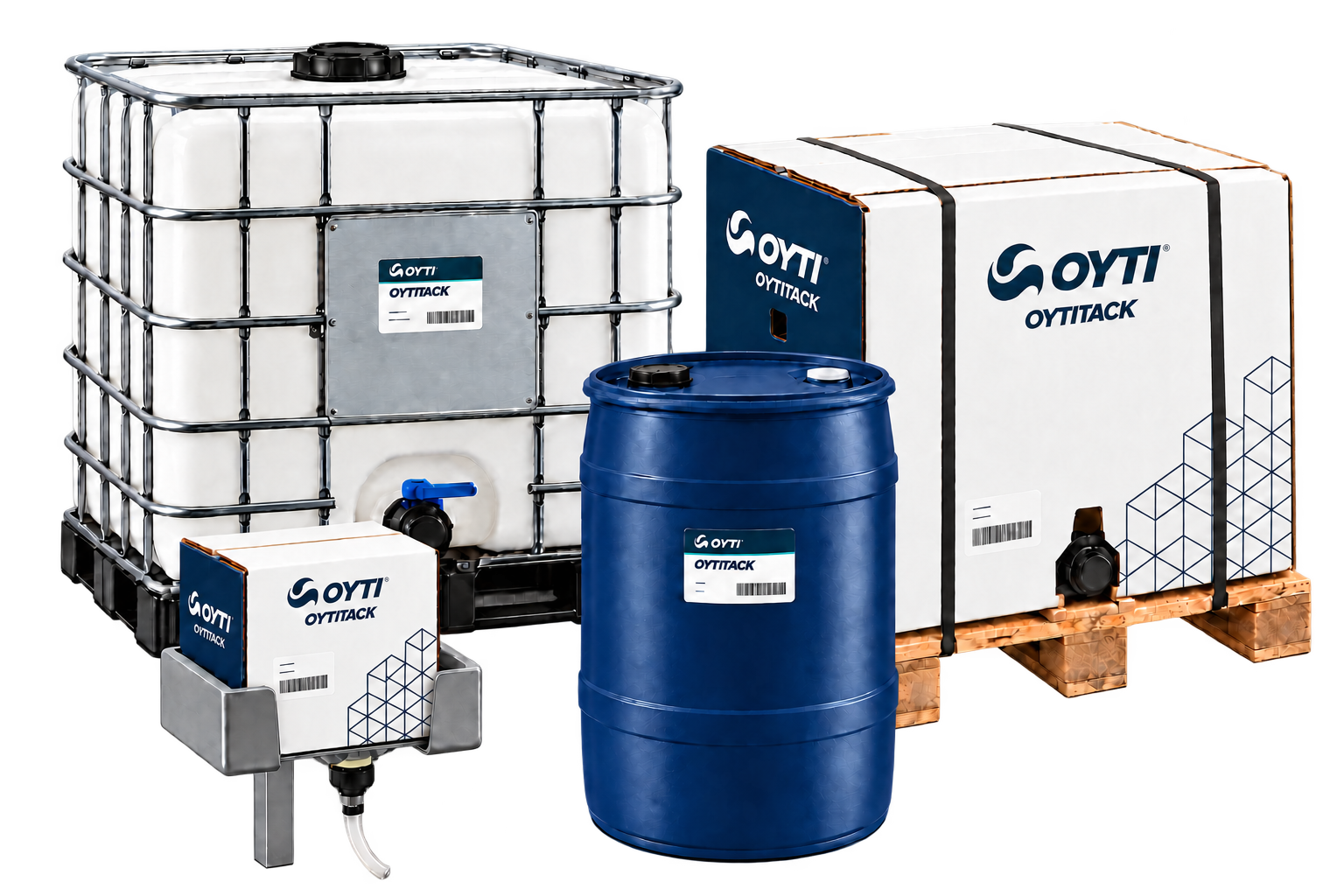
FROM SELECTION TO PRODUCTION
Identify substrates, component shape and application method.
Match the adhesive grade and system to your production setup.
Evaluate initial hold, bond quality and handling time.
Processing conditions and performance depend on the selected grade, substrates and application. Our team can provide the relevant technical data.
OYTITACK / SMALL DETAILS. BETTER DECISIONS.
Turn a promising sample into a repeatable production method. These questions help structure a useful trial.
The purchase price per kilogram is only one input. Record adhesive used for accepted components, alongside overspray, startup losses and rework. Compare alternative settings at the same required bond quality; a lower application amount is useful only when performance is maintained.
Check handling strength and moisture release in the actual construction. Dense covers, multiple layers and the production environment can change the drying path. A surface that feels ready is not, by itself, evidence that the complete assembly is ready for wrapping.
More adhesive does not automatically create a better component. Local accumulation can influence the feel of a soft assembly. Inspect coverage and compare both bond integrity and flexibility after conditioning.
Review material compatibility, application equipment, cleaning procedure and joining sequence together. Start with a controlled trial and document the settings that give a repeatable result before changing the production line.
It describes the carrier system, not a complete emissions profile. Solvent content, emissions testing and any certification need to be confirmed for the selected adhesive. Use current product documentation for customer-specific requirements.
Follow the selected grade’s storage limits and shelf life. Many water-based dispersions are sensitive to freezing. Keep containers properly closed and use the recommended cleaning routine before residues dry inside application equipment.
WHERE IT WORKS
LET’S BUILD THE NEXT BOND.
Tell us which foams and cover materials you use, how you apply adhesive and how quickly parts need to be assembled.
Talk to our teaminfo@oyti-adhesives.com+90 226 400 00 27